Friday, July 4, 2014

Buyer beware!

I've had a few days home with the flu - which gave me time to wander my way through all the Crown Lynn listings on TradeMe... and I was pretty appalled by what I found. 

A novice collector in particular could very easily be caught out by some listings which are advertised as Crown Lynn when they patently are not. 

'Crown Lynn???' does not mean Crown Lynn.  Nor does 'In the style of Crown Lynn' or 'Might be Crown Lynn' or 'It is not marked but I have no doubt that it was made by Crown Lynn' or other such assertions.

Generally, I have to believe that the seller is acting with integrity, but there are a few cases where I wonder. There are a couple of traders who are notorious for advertising items as 'Crown Lynn' - usually  with a few question marks, and using that same heading for countless re-listings no matter how often they are told that they are wrong.   Unfortunately I can't name that trader but I would love to!

Crown Lynn is very complex, and as we all know it's not always easy to establish what is and what is not Crown Lynn.  Without blowing my own trumpet, (much!) my Crown Lynn Collector's Handbook is a very useful guide. 

First let's deal with what is Crown Lynn. Many CL items are unmarked, and many others bear marks which appear to have no relation to Crown Lynn.  I have given three common examples below.

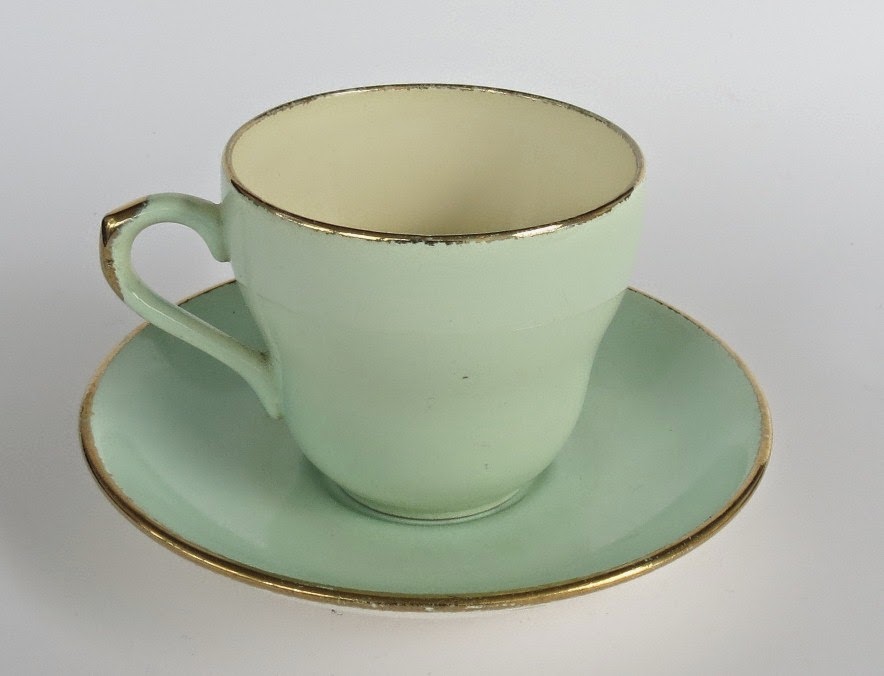
This lovely duo is marked 'Symphony British'.
This gorgeous honey glaze beer stein carries the very common Crown Lynn four-digit shape number and 'Made in New Zealand' in capitals. (I love the way honey glaze comes up so beautifully in photos. How can I ever have been derisive about this ware - but indeed I was)


And this handkerchief dish from the 1940s has only a three-digit shape number, as was common practice at that time.

You will also come across dinnerware marked with 'Genuine Ironstone' or 'Contemporary Ceramics' - or a slew of other brands all used by Crown Lynn.

So where can we get into trouble and buy what is not Crown Lynn?  There are two very common pitfalls - Hobby Ceramics and the Crown Lynn replicas made by Studio Ceramics. 

A while ago there was a white 'Crown Lynn' shell on TradeMe which gave me buyer's envy - mine is rather garish and I would have much preferred the white.  Then, after it had sold, I realised that Studio Ceramics makes a white version and that's probably what was on TradeMe... but saying that, I can't guarantee that CL never made a white shell! 

Studio Ceramics has in no way attempted to mis-represent what they make, and you often see items listed 'Crown Lynn replica' and the like, which is perfectly acceptable.  For the record, here is the link to the Studio Ceramics Retro Lynn range currently in production.  I believe that the replicas are now backstamped Studio Ceramics but that may not always have been the case in the past.

Then we have Hobby Ceramics.  This was hugely popular in the 1980s/1990s - you went to a class and were given a bisque ware 'blank' which you painted with supplied glazes in your own design. Your work was then fired and you took it home.  Some Crown Lynn shapes found their way into Hobby Ceramics classes.  This dish for example is almost exactly the same as the lovely version decorated by Frank Carpay below... but it is Hobby Ceramics.
 
Besides the quality of the artwork, the clue is on the base. In the pic below you can see the familiar Crown Lynn shape number 2142, but there is also a scratched mark - the initials of the person who hand-painted it. In addition most Hobby Ceramics items look amateurish - ceramic decoration is a skilled occupation that you can't learn in a single class.  Hobby Ceramic glazes are also quite distinctive - the pale speckly effect above was quite popular. 
Experienced buyers are aware of the pitfalls of Hobby Ceramics, so if you see something that seems to be rather special but no-one else is bidding, perhaps you need to reconsider. You can pretty much guarantee that other collectors will have seen the listing and decided there's something odd about it.
 
Yet another common pitfall is to see other NZ manufacturers' works listed as Crown Lynn - for example 'Clay Craft/Crown Lynn.'   Clay Craft had nothing to do with Crown Lynn. It was a totally separate company, making completely different ware - lovely and collectable in its own right, but not Crown Lynn.  The same applies to many other NZ manufacturers, eg Orzel, Temuka etc.
 
However Titian and Luke Adams are both associated with Crown Lynn, and I will tackle their stories another time. Both were taken over by Crown Lynn, so some of their output can be attributed to Crown Lynn and some cannot. The honey glaze beer stein above is very typical of the type of ware made at the Titian factory after the takeover. 
 
In summary, it is buyer beware out there. Although recent legislation has given online buyers more protection, I don't like your chances of getting your money back if you buy something that proves not to be authentic. I can't emphasise enough, if an item seems too good to be true it probably is. If it's as rare and valuable as the seller implies, then others will be bidding. If not, it is either not authentic or overpriced. Or both.
 
There are not a lot of misleading entries, but enough to cause concern.
 
Lastly - life is full of surprises!  Recently the New Zealand Pottery site had some discussion about Crown Lynn made in Mexico.  Huh??? Mexico???? In all my years researching and collecting, I had never come across this connection, but now we have a backstamped item to prove it - it appears that Crown Lynn commissioned some work from the Lofisa factory in Mexico.  As you will see from the discussion on this link, there is still a lot to be discovered about this Mexican connection.
 
More soon
ValM


Wednesday, June 4, 2014

Classic "English" - Wentworth Ware and Fancy Fayre

Just imagine their pride when Tom Clark and his team managed to make this gorgeous thing:
For years they strove to create a white clay body, and struggled with primitive largely self-taught decorating and firing techniques - in isolation because of the war.  Then, in 1948 it all came together, importantly with the help of experts recruited from England.  What whoops of joy there must have been when these little compotes first came out of the kiln looking like this.  And this:
My lovely bright yellow specimen is a recent acquisition - a lucky $10 find in a Kaihohe second-hand shop.  These dishes would both have been made in the 1950s. They are the same shape and size, height 4.5 cm, length 16, width 13.   The gold decoration was another development introduced by the newly recruited English decorators in the late 1940s.  The yellow and gold version is unmarked apart from a number impressed in the base.  The hand-coloured one carries the Wentworth Ware backstamp.
In the photo above you can also see the shape number, 125, which looks as though it was pressed into the soft clay after it came out of the mould. In almost every case, Crown Lynn gave each new shape a number, which makes it easier to identify Crown Lynn products even when they don't have a backstamp. 
And Wentworth Ware.. .where did that brand come from? In the 1950s many New Zealanders were a bit snobby... they preferred to buy china made in England, which was often referred to as 'home' even by people who were born in NZ.  My grandmother, for example, would never have had Crown Lynn in her home. Tom Clark once publicly described NZ housewives as snobs, which created a rather unpleasant backlash.
This pink grape leaf is another in the Wentworth Ware series. I am a bit disappointed in this photo, the pink is brighter in real life. 
The base is unmarked apart from a shape number, 147, which looks as though it has been scratched into the soft clay when it first came out of the mould.
Yet another in the Wentworth Ware series is this gorgeous bright yellow dish, about the size you might use to serve a few yummy little chocolates after dinner. I am having a love affair with this yellow glaze. It is so very very bright and cheery.
The dish is shape number 410.
Alongside Wentworth Ware, Crown Lynn made Fancy Fayre salad ware, a blatant copy of the lettuce leaf styled ware being made by Carlton and others in England. This jug featured in my first book. It is 14 cm tall.
This is the backstamp. You can also see the shape number, 409-1.  The number 1 denotes the size. The next size up would have been 409-2.
This is my treasured salad dressing jug. I found the jug years ago, and only recently bought its matching little plate on TradeMe. The jug is 9 cm high and 17 cm end-to-end. The saucer is 17 cm long.
The jug has the Fancy Fayre backstamp, the saucer has a shape number only. This set is hand-coloured in pastel shades, much softer than the bright milk jug above.  Here is the saucer shape number, and also a little red mark which must have been applied by the decorator for some reason. Quite often you find marks of this sort on the base of Crown Lynn ware, most probably because they were testing a new material or process - or simply because someone wanted to clearly identify their work for some reason.
That's all for now. Keep warm!
More soon
ValM
 

Saturday, May 17, 2014

A gorgeous retro caravan, Autumn Splendour and the Beach Hop

A couple of weeks ago my friends Annie and Simon Dawn took their lovely caravan  Louisa Ann - built by Annie's dad in 1962 - to the Whangamata Beach Hop.  Annie and her niece Julie Jones served up high tea on my Crown Lynn Autumn Splendour.  And this is what the table looked like:
Lots of people just love Autumn Splendour but I am not such a fan, it was too much of a cliché during my 'formative years'.  But my daughter is young enough to appreciate it so she has first dibs on my set.
Anyway, I digress. Here are Annie and Julie with the Louisa Ann, in their matching retro dresses they made from an authentic 1960s pattern.
The Louisa Ann is one of only about 12 distinctive Everson's Deluxe Caravans, Annie's dad Ern really only made them for family and friends. Several are still on the road, including one at the beach hop which belongs to another branch of the family. Inside the Louisa Ann is bit less plush than modern caravans - there are lots of rivets and the sturdy aircraft aluminium is exposed, but it's very cosy and Annie and Simon have been all over NZ in her for months at a time. The original Formica is still in great shape - here is the all-important swan and my books on display.
From all reports the girls had an excellent day, and I am so happy and proud that my Crown Lynn was used in such a great way.  Go Annie and Julie!
I do love to see Crown Lynn being used and enjoyed, and for that reason I can't resist adding this pic of my Book Club supper setting - I didn't have time to dig out matching trios so we had mix 'n match, which worked just as well if not better.
More soon
Keep warm
ValM

Thursday, April 17, 2014

DANIEL STEENSTRA - hand potter

For years I have been meaning to do a post about Daniel Steenstra but I keep putting it off because I don't know enough. So I have finally decided to put down what I do know - we can always add to it later! I would very much appreciate any comments/corrections/further information on this post.. it has got a few assumptions, and more than a few gaps!

Meanwhile, here is a picture of Daniel Steenstra at work. It is taken from a large newspaper advertisement  - undated, but almost certainly 1960s. He was demonstrating his craft at the Crown Lynn shop in the Milne and Choyce department store in Queen Street, Auckland.
This is a vase which I am confident that Steenstra made and decorated. It was hand potted, then coloured slip was dabbed on to create a mottled effect. The horizontal lines are hand-incised grooves. He also made plant pots and lidded kitchen jars in the same style.
Another picture from the newspaper advertisement shows the types of vases Steenstra was making at the time. Imagine if you had all those on a shelf today...   The planter  in the top right hand corner is decorated in the same pattern as the vase above.
This link on the New Zealand Pottery site will take you through to a very interesting range of examples of work believed to be by Daniel Steenstra. (except that nothing in my records would indicate that he made the dogs shown in one post.)
 
Daniel Steenstra began work at Crown Lynn in 1953, and worked there for about 20 years. Occasionally during downturns he was put off, and had to find work elsewhere.  In the end, as Crown Lynn became more mechanised, his skills became less and less relevant and he moved to Beach Artware, a much smaller pottery.  He died in 2000 before I began my Crown Lynn research but in 2004-2005 I spoke to his wife Wendy and his son Dominicus, and also to Israe Paraone, who  worked closely with him in the 1970s.  
 
For many years I have struggled with a basic conflict over Daniel Steenstra. Some people told me he decorated his own work; others said his vases were painted by Crown Lynn hand decorators such as Frank Carpay, Doris Bird and Eileen Machin. Happily, I think I am now a bit clearer about this question. One clue is in my interview notes with Israe Paraone, who  told me that Steenstra did paint his own work, and described his technique (see below).  My interview notes from Eileen Machin tell me that some Steenstra pots were hand painted by Eileen and her colleagues, while others - described as 'outdoor pots' were slip banded by Daniel on the wheel.
 
So my educated guess is that Steenstra decorated vases and planters in the style of my vase above, and that he also occasionally decorated other items, but most of his vases were hand painted by other people.
 
Everyone who spoke about Steenstra told me that he was incredibly skilled with his hands. Israe Paraone told me that he could roll a cigarette one-handed, in his pocket. 'He would roll my cigarettes for the day – and look at you and grin.'  (EDIT - I did have a reference here to Steenstra's hands being damaged in the war, but his family says that is not true so I have removed it.)
 
Israe described Steenstra's decorating technique like this: ' Danny would … mix up all the slip and glazes that go together in the weirdest way, use part of a torn old jumper, (as a paintbrush) and he would have two fish swimming underwater in the weirdest way...He was a very humorous, very talented, very funny guy. He had a quiet pride, he didn’t need the acclaim.'
 
Israe and Dominicus both told me that Daniel Steenstra helped the design team by making one-off samples as they were developing new shapes, and Israe said he also understood machinery and was a powerful innovator in how some of the processes at Crown Lynn evolved.
 
Both Crown Lynn founder Sir Tom Clark, and long-term finance manager and later GM Colin Leitch told me that Steenstra made lots and lots of very small items.  Many were decorated in white, said Colin. This little treasure, no more than 6 cm tall, was found by John Shears - thanks John for the photos.  
Steenstra's  skills were such that he could hand-pot a jar and lid, and the lid would fit perfectly without measuring; this is a highly technical skill. Sir Tom told me that Steenstra was 'the sharpest smartest thrower you ever saw in your life. Just throwing. One piece after the other, boom boom boom ....he was a very hard worker. Did a tremendous job.'  However Sir Tom told me he fell out with Dan Steenstra over money - he wanted more pay than Tom was prepared to give.

It is generally believed that these larger green vases with white dots were also made and decorated by Dan Steenstra, though I have not yet seen any documentation to confirm this. (photo thanks to Geoffrey and Brenda Clark). I have read that there were eight different vase shapes in this style.
Lastly, I have a handful of other small vases which I believe were made by Daniel Steenstra though once again I have no proof.  Somewhere I have a note that he made little 'baroque' vases - but for the life of me I can't find that note now when I need it! At any rate, here are my small vases, the largest is only 8 cm tall. This is not the first time these vases have appeared on this site.. forgive me, but I do love them!
So. I hope that as time goes by we can put together more and more pieces of the Daniel Steenstra puzzle. He is one of the many unsung heroes of Crown Lynn.

NOTE... After I posted this, Ev from the New Zealand Pottery site gave me a link to the Auckland Museum Library site, which has some photos of Daniel Steenstra at work.  It's a bit tricky - click on the link below, then click on the listing for Crown Lynn, then you  will see eight pages of listings of photos etc. The pics of Steenstra are on pages 7 and 8.
http://muse.aucklandmuseum.com/databases/librarycatalogue/P5206.detail

But now it's stopped raining (finally) and I am going to see what's left in our vege garden after a week of rain and wind and rain and wind...

Take care
ValM


Wednesday, April 2, 2014

MADE IN NEW ZEALAND... my favourite dinnerware patterns

I have been digging through my boxes in preparation for my giant Crown Lynn garage sale... yes it's time to clear out a bit of space in our shed!  Anyway, that won't be for a couple of months yet.  But it has made me think about what I like and why.  And Nirvana, perhaps surprisingly, is my all-time favourite.  It's so very New Zealand, based on our pohutukawa flowers.  And just look at the glow in that background glaze. I don't know who designed it; probably Crown Lynn's long-term in-house head of design David Jenkin.  The desert plates in my set are the plain sandy colour.
Sadly, George has not yet come round to my way of thinking on this one, so my Nirvana dinner set remains in the garage. But I won't be selling it.
Second on my list is the cool elegance of Four Seasons... and this pattern gets a bonus point because of the lovely quirky backstamp. This is one of several banded patterns which were made by spraying coloured slip (liquid clay) onto the unglazed ware then overspraying with clear glaze, which makes for a very durable finish. Other banded patterns, released around the mid-1960s, were Hacienda and Carousel.  I wish I'd gathered up more Four Seasons when it was still around. Now you never see it, at least not at prices I am prepared to pay.
And here's my all-time favourite backstamp.
Next on the list has to be Echo. Once again, I have a full dinner set in the garage and he-who-must-be-obeyed is not keen on it. Oh well, I won't be selling it so I hope my descendants like it.  Echo was designed by Mark Cleverley, newly recruited to the Crown Lynn design team and described as drawing the design with 'reckless abandon' to appeal to the 'flower power' generation. Released in 1969, it proved to be one of the best sellers ever, and is one of the most instantly recognisable Crown Lynn designs.
Then there's Apollo. Simple fluted white, durable and - unlike many dinnerware patterns - very unobtrusive to eat off. In the past couple of years, the once ubiquitous Apollo has all but disappeared from op shops... I guess I'm not the only one who appreciates it. Apollo was released in 1969, and named to commemorate the first landing on the moon.

Yucatan, designed by Robert Drake, is another favourite. The late 1960s were outstanding years for Crown Lynn design, this pattern was released in 1968, the year I got married. Uncle Graham and Auntie Pam gave us a full dinner set for a wedding present. I wish I'd kept it in its box instead of using it; now I only have a few battered relics.  The cups and bowls were plain grey.
 

By the mid-1960s, Crown Lynn was in full production, using the automated Murray Curvex machines to print in-house designs such as Yucatan and Echo. These machines used a gelatine 'bomb' - a sort of half-sphere with a jelly consistency, to transfer ink from an engraved metal plate to unglazed bisque ware. It revolutionised production, both in terms of speed and also because it gave Crown Lynn the ability to decorate flatware without the laborious hand-application of transfers.  (The popular Autumn Splendour is a well known pattern which was applied as a transfer.)
 
This pattern below is another I am very fond of - and it too is very hard to come by.  It's an earlier pattern; its "British" backstamp and the shape of the plate places it in the 1950s or very early 1960s. I love the turquoise glaze, and the simplicity.
Crown Lynn used "British" backstamps in an attempt to hoodwink New Zealand customers into believing they were buying English-made ware.
And - last but not least, this plate at first glance looks like a big brown blob, but let me tell you this is very classy. It was designed by David Jenkin and Mark Cleverley in 1977 for the Bellamy's restaurant in Parliament Buildings. The very stylish MP Whetu Tirikatene-Sullivan oversaw the process, and the end result was a stylised Maori fish-hook design with an amazingly rich finish. This photo does not do it justice; in the real thing you can see rich purple shades glowing in the varied shades of brown. I have only ever found one plate, and it's another that won't be in the garage sale!
More next time.

ValM


Tuesday, March 4, 2014

Swans, figurines, vases... exhibition in Whangarei and a talk on 16th March

The Whangarei Art Gallery has an exceptional exhibition of Crown Lynn treasures, some mine, but mostly belonging to another big collector.

Heather and I are doing a talk about our collections and about Crown Lynn in general at 2 pm on Sunday 16 March - and afternoon tea will be served on Crown Lynn!  This is a fundraiser for the Whangarei Music Society so there will be a $15 door charge, on that afternoon only. The rest of the time the art gallery appreciates a small donation from visitors.

The Whangarei art gallery is open daily from 10 am to 4 pm. It is at the bottom end of Dent St, in the Town Basin, and it is well signposted. The exhibition runs until April 20. It is curated by Scott Pothan.

There is a huge parade of swans, including rare trickle glaze examples, and also a big family of animal figurines. Not to mention the whiteware vases! Just look at this lovely wee dog saying hello to the equally lovely - and rare - cat.  The dog is probably 1940s, the cat 1950s.
These two early swans are among my favourites.
 The small one has interesting scalloped tops to its feathers - quite different from the later version (see pic below) which is smoother around the top.  When Crown Lynn first began making swans, they were very limited in the way they decorated them. Through the 1940s, the trickle glaze (flowing glaze) technique was developed and refined until they were producing some stunning decorations. Later, from 1948, they used the white glaze which is more commonly associated with the classic Crown Lynn swan. This little white swan below, unlike most others, has a yellow beak and eyes outlined in black.

This grey swan is another very interesting example - probably my favourite at the entire exhibition. It is finished in a thinner dark grey glaze - compare with the more usual - but still rare - black swan in the background. The grey looks like a 1980s glaze but we can't be sure.
I could go on and on and on about the swans.. there are plenty more to be seen at the exhibition - but I am delighted by the animal figurines on display as well. A gorgeous line-up of bambi deer in different colours. These are also 1950s I think - or even early 1960s.  By this time Crown Lynn had become much more skilled in both modelling and glazing and these are real quality items. And quite large at about 15 cm.
Then there's an extensive array of dogs and other animals, all carefully arranged and looking just great. There is even a camel, and a goat - both very rare.
Here is a group of carnivores, all so sleek and predatory. There is no doubt that there were some very skilled modellers working at Crown Lynn. These animals aren't mine - and therein lies a sob story. I once saw a black fox on a shop counter in Waipu, inexpensive too. And I went ummm not sure, that can't be Crown Lynn. And left it there. Oh well. Someone else would have been thrilled to find it.
Another of my favourites is this very early dog. This would have been made when the little team at Ambrico were very much just feeling their way, trying to work out how to make the clay body (which is a mix of several different types of clay and other minerals), how to model the clay and how to glaze it successfully. Not to mention how to fire it. But there are quite a few of these wee dogs still around so they must have been popular. Despite its primitive form it has real life and energy. 
This bird ashtray is another early example. I have never seen another.
As I said, I could go on and on. Just look a this brilliant lineup of kiwi vases, again all trickle glazed, 1940s.
And the vases.  In the foreground is a very early kitchen bowl, also trickle glazed. At this exhibition, these items are all beautifully displayed and lit. It is a real treat to be able to closely examine the stunning colour combinations.
And there's a section of whiteware vases... what can I say?  (They are a brighter white than I show in this photo, which was taken in low light.)
This really is an exceptional exhibition, and I do recommend that you come and see it if possible. I don't imagine it will be seen anywhere else in NZ - so come to Whangarei and give yourself a treat!   And as a bonus, the gallery is also showing (for the first time in NZ ) a selection of Len Lye paintings from the 1930s and also some exceptional artwork by Graham Percy, who did a lot of work for the School Journals. 
 
I hope you can make it for the talk and afternoon tea on the 16th of March - do remember that there is a $15 cover charge for that event only.  The rest of the time the art gallery appreciates a small donation on entry.  The exhibition runs until Easter - it closes on April 20.
 
That's all for now. My next little project is to dig out some cups and saucers to serve the afternoon tea on! I have a few...
 
More soon
ValM