Monday, February 21, 2022

BOB STEINER


Artist and craftsman


Perhaps best known for his bright bold glazes from the 1990s and 2000s, Aucklander Bob Steiner is an accomplished sculptor as well as a ceramicist. This post tells his story from a teenage enthusiasm for hand-thrown pottery to the remarkable range of castware he produces today. 


Bob Steiner at work in his studio
Image courtesy Bob Steiner 

Click here for Bob Steiner's website 
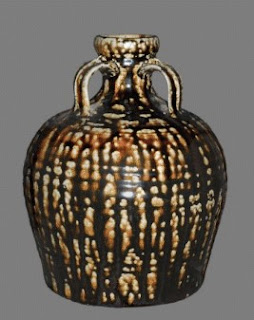
Bob Steiner started potting at the age of 14.  He worked with clay dug from the family land and fired his pots in a home-built kiln. He was so enthusiastic that his father bought him a potter’s wheel as a 15th birthday present.   After a stint studying pottery and sculpture at Elam Art School, Steiner and his partner Lynn headed for the remote Hokianga in the Far North.  There, the couple had three children and built their own house. Bob made a living from pottery, supplemented by part-time jobs like driving the local school bus. Lynn worked as a school teacher.   Bob's pots were hand-thrown on the wheel and fired in a large wood and diesel kiln. Even then, Steiner was searching for new ways to work.  “My bible was  A Potters Book by Bernard Leitch.   It led me into the amazing world of ash glazing and I would run around the hills gathering plants and leaves to burn and wash and mix.”  
Early salt glazed wine bottle made by Bob Steiner in his teens in Birkenhead (1968)
Image Bob Steiner  

In 1984 Bob Steiner moved back to Auckland after his marriage ended.  He soon met up with ceramic artists Christine Harris and Rose Wallis, both based at the D’Art Studios co-operative, and their work inspired him to move from earthy hand-thrown ware to slipcasting and decorating in bright clear colours. 

In the Hokianga, Steiner had been experimenting with his hand-thrown pieces, slicing them with a knife or thin wire and reshaping them by hand to create angular forms that could not be achieved using a wheel alone. In Auckland he learned how to replicate the new shapes over and over by slipcasting in moulds.  The new techniques created the popular 'Swirl' teaset, with its unusual curves and cut-out lids. Other ware created in this way included the Swirl dinner set – its plates and bowls had cut-out sides.    

Swirl tea set C1985
Image Bob Steiner

Often glazed with different shades inside and out, Bob Steiner’s new ware was snapped up by Aucklanders looking for new lively shapes and fresh bright colours. A Swirl tea-set gained a merit award in the 1986 Fletcher Brownbuilt ceramic awards.  

Initially working mostly on his own, Steiner developed his shapes and techniques and used plain glazes rather than brushwork. Rose Wallis decorated some early work with floral patterns. New shapes included deco-style ware - mugs, teapots, milk jugs and sugar bowls.  

At first production was on a small scale.  He sold from the D’Art Studio premises, and sometimes from stalls at the Victoria Park and Oriental Markets. Soon shops throughout New Zealand were keen to stock his work. One prominent retailer was the New Vision Gallery in Auckland. 

The business stepped up in 1988 when Steiner established a workshop in his basement at home and began working with ceramic artist Sharyn Maude.  Together they developed a range decorated with brightly coloured brushwork. Most of their collaborative work bears the Eido stamp.  The pair joined the Pots of Ponsonby co-operative and had a very successful four years before going their separate ways.  For a time after the partnership ended, Sharyn Maude made very similar mugs, marked with her name only.

Early deco teapot. Decoration by Sharyn Maude C1988
Image Bob Steiner 

This Hexagonal coffee set is an early creation.  It was decorated by Sharyn Maude C1988/1989, Coffee pot height 22 cm
Valerie Monk

Occasionally collectors come across Crown Lynn shapes with the Steiner/Sharyn Maude Eido backstamp.  After Crown Lynn closed in 1989, Steiner bought a whole lot of unglazed blanks – mainly dinner plates and a few odds and ends like gravy boats from the 1980s Modello Collection.  The blanks were decorated at the Steiner workshops and on-sold. 

Gravy boat decorated by Sharyn Maude.  The blank was purchased at the Crown Lynn factory closure. 
Valerie Monk 

Many of the shapes Bob Steiner developed during the late 1980s-1990s are still in production – for example tall Cuba jugs, vases, assorted mugs and coffee pots, and teapots and cups and saucers.  A classic rounded teapot set was inspired by the German Bauhaus design movement.  

This teapot from the late 1980s is still popular
Image Bob Steiner
 

A line of vases still being made today dates back to Bob’s original technique, slicing and reshaping hand-thrown ware. The Cactus, Round Leaf and Pointed Leaf vases were first made in 1986.  They were difficult to slipcast until the moulds were remade by retired Crown Lynn modeller John Cowdery.  

Steiner vases.  From left, Cactus, Round Leaf, Pointed Leaf. Cactus vase height 40cm
Image Bob Steiner
 

After a decade working in co-operatives, in 1991 Bob Steiner opened his own workshop and retail business at 440 Kingsland Road.  For a couple of years he also sold at Pots of Ponsonby but that relationship faded as turnover grew at the main shop.  After the move to Kingsland, Bob ventured into more sculptural work, including striking eccentric pieces like his rockets and lionfish. 


Wall-mounted lionfish decorated by Frana Stanish. Recently brought back into production, the lionfish are now sold in plain glazes only. Largest lionfish height 28 cm
Valerie Monk 

By now Bob had joined forces with Frana Stanish and together they developed a range of colourful patterns applied with brushes and hand-cut sponges.    At its height the business employed five women decorators. The best-selling design was Aster which came in three colourways – marigold, purple and green. The Cactus and Anemone patterns were also popular. These sponged and hand-brushed styles peaked around the mid-1990s.  In 1996 Frana Stanish left the business, but her patterns were replicated for a couple more years by another decorator, Jo McClean. 

Steiner mugs in Cactus, Marigold Aster and Anemone patterns. Decorated by Frana Stanish 
Valerie Monk 

Toward the end of the 1990s the market for multi-coloured hand painted ware was fading and Steiner created his bold single-colour matt glazes, including the very popular electric blue.  

Towering Steiner Cuba jugs in colourful glazes were first made in the late 1990s. When he was modelling this jug, Bob dropped a cylinder of clay on the floor to flatten the base, and to create a more relaxed shape. Every slipcast jug carries his handprint on one side, where he squeezed the  soft raw clay shape of the original.   The same form was used as Cuba Vases and later Cuba lights. Jug height 40cm
Image Bob Steiner

In 2002 Reg Matthews, originally from Beach Artware, began working with Bob Steiner.  He suggested a range of square wall hangings. Inspired by his association with the native bush in the Hokianga, Bob developed a very successful new line of wall art, at first rectangular and square plaques, and later birds, leaves and flowers. All of these pieces can be arranged on a wall in an endless variety of configurations. 

Steiner wall plaques form an exquisite memorial at Mercy Hospice in Ponsonby. Bereaved families are able to buy a plaque to remember a loved one, and proceeds go to the hospice.  The plaques are arranged on walls surrounding a peaceful courtyard.   The project began in the early 2000s and continues to this day. Here, a new plaque is being added to the wall.
Image Bob Steiner

In 2009 Steiner Studios moved from the home workshop to a purpose-built pottery in Avondale.  In 2002 Bob remarried and his wife Alison Steiner was very active in the business, particularly in management, business development and strategy. Bob and Alison had a son together. 

Today, a small team continues to recreate Bob Steiner classics – and he still keeps the work exciting by creating new pieces. New shapes are first roughed out in clay, then finely sculpted in plaster.  Slipcasting moulds are made from the final plaster prototype. 

Wall decoration assembled from Steiner flowers, birds and leaves
Image Bob Steiner 

Steiner takes much of his inspiration from New Zealand culture, often incorporating tapa and koru designs. Looking to nature for inspiration, there are skillfully rendered flowers, leaves, birds, bees, and a sea creatures series including shells, starfish and fish. Some small dip bowls were created using the direct imprint of a leaf – eg totara, taraire and fern.  Birds include the New Zealand ruru, tui and the ever-popular fantail (piwakawaka). 


Steiner Fantail (Piwakawaka)  Approx height 15 cm
Image Bob Steiner

Above: Steiner once bought a fresh hapuku - a substantial purchase at $100.   A wall decoration was modelled from the complete fish, and then it was turned into a sumptuous meal.   Later,  the picked-over skeleton served an artistic purpose.  The bones were cleaned then used to model a series of decorative wall plaques.  
Image Bob Steiner

Some Steiner pieces are quite quirky – for example a kiwi steps directly out of the wall, and there’s a snapper head with ears and another with horns.   A decorative rocket in four different sizes has engendered speculation over the years – it has even been mistaken for a half-peeled corn cob. 

Steiner wall rocket
Private collection 

Bob Steiner has also made one-off sculptures, some simply for his own satisfaction and others for fundraising for organisations, eg Tiritiri Matangi Island.  

The Time Bomb, a one-off humorous clock
Image Bob Steiner

Soda-glazed bowl originally sculpted as a fundraiser for Titirtiri Matangi Island bird sanctuary
Image Bob Steiner

In addition, the classic Steiner dishes, ornamental jugs, lamp bases, teapots, mugs and vases still sell well.

Classic Steiner cup and saucer sets
Image Bob Steiner 

Other more pragmatic work includes the development of stylish and durable restaurant ware.  For the hospitality industry, ware must resist chipping and staining, and be able to withstand endless dishwashing cycles. That work has paid off, now Steiner ware is used by many of Auckland’s top eateries. 

Restaurant ware
Image Bob Steiner


Bob Steiner timeline

1974 began professional pottery in Kohukohu in the Hokianga . Hand-thrown ware carries the impressed volcano mark symbolising earth and fire. 

1984 – moved back to Auckland and began making cut-sided ware, including plates, bowls, tea sets.  Deco cups were also quite early and later deco teapots with the zig-zag pointed handles.  Ware from this period is marked with the Bob Steiner New Zealand signature stamp (see backstamps below).

C1985-1991 Eido branded with Sharyn Maude 

1986 Fletcher Brownbuilt Awards certificate of merit

1986 D’Art Studio folded and Steiner travelled to the US. 

1988 After return from overseas, set up a workshop in his basement  

1991 – opened Steiner Studios shop in Kingsland 

From 1992 - C1997 Frana Stanish two backstamps. Frana and then the smaller FS  

C1993/4 single colour matt glazes developed 

1997 Steiner began putting dates on his backstamps from this year

2002-2003 Reg Matthews joined, began making wall art   

2005 wall art first appears in trade show displays 

2005 transparent stick-on labels used

C2003 began making dip bowls imprinted with natural leaves  

2008 piwakawaka and large tui appear in trade show displays

2008 wall art squares appear in trade show displays

2008 University of Auckland 125 years commemorative gift 

2009 wall art flowers appear in trade show displays

2009 moved from a home workshop to new premises in Avondale 

2010 first lamp bases in trade show displays

2012 large snapper in trade show displays 


Bob Steiner marks and backstamps. 
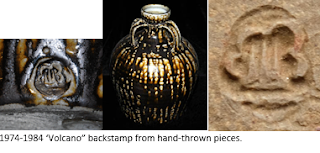


1974-1984"Volcano" mark on hand-thrown pieces.  


1984-C1986 Bob Steiner stamped signature (the triangular mark below the signature is of unknown purpose) 


1985-1991 Eido mark with Sharyn Maude 


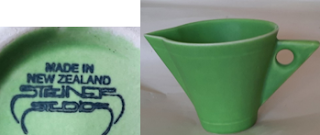
1992-C1997 Made in New Zealand Steiner Studios


1992 Made in New Zealand Steiner Studios Frana Handpainted


1992-1997 Made in New Zealand Steiner Studios FS and Steiner Studios FS


C1992-C1999  Made in New Zealand Steiner Studios (Frana pattern painted by another decorator) 


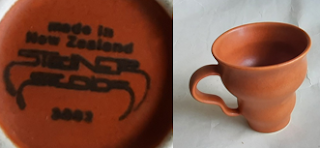
1997-2002 Made in New Zealand Steiner Studios 97 (I believe 1997 was the first year Steiner dated his ware) 


Made in New Zealand Steiner Studios 2002


2008 Auckland University commemoration 


Made in New Zealand Steiner Ceramics 2008


Bob Steiner Ceramics 2009 


2010 Steiner Ceramics New Zealand stamp plus New Zealand Flora Kawakawa sticker 


2015 Steiner Ceramics NZ (Kiwi stepping out of the wall) 


C2018 Steiner NZ


2019 Steiner Ceramics NZ 


2020 Steiner NZ 

From 1996 Blue Ponga Designs 


2004 Bob Steiner Ceramics New Zealand (impressed)


2004 or 2005 New Zealand impressed (pipi dip bowl) 


Made in New Zealand Steiner Ceramics by Bob Steiner (transparent sticker) Date uncertain


Bob Steiner Ceramics New Zealand (transparent sticker)  date unknown 

ENDS 

The information for this post came from: 
  • Bob Steiner's website www.steinerceramics.co.nz
  • Interviews with Bob Steiner by Valerie Monk and Ev Williams (2016) 
  • Following that interview, Bob provided me with a  selection of photographs and catalogues, and also added more information via informal conversations, documents and emails. 
  • The New Zealand Pottery website www.newzealandpottery.net
  • Thanks also to Alison Steiner who complied records for my use and for future researchers. 


Saturday, November 7, 2020

PETRA CERAMICS 1988-2007

I treasure my Petra Ceramics collection for its fresh bright colours, hand-painted onto some of the whitest and most durable ware in the business. Below are some of my Petra jugs. The largest is 6.5 cm tall.  

This is the story of Petra Ceramics, as told to me by Petra herself.  

German-born, Petra Donath came to New Zealand in the mid-1980s when she was 30 years old. Like many Aucklanders at that time she went to pottery night classes, hoping to learn new skills and also to meet people and improve her English.  Petra didn’t take to hand-throwing but then a chance meeting with Christine Harris led her to slipcasting.

Inspired by Christine’s bold colourful mugs and vases, Petra and her electrician husband Murray de Lacey set up a workshop in an empty building on Karangahape Road – and Petra Potz was born. 

Petra’s first materials – and a lot of help and advice – came from Quentin and Kathy Whitehouse who ran Western Potters Supplies. By the late 1980s New Zealanders were craving colour and Western Potters had begun selling bright new decorative pottery stains. Petra was soon buying moulds, slip, colours and glazes from Western Potters, all carted across Auckland in her little Morris Minor car.

Above: Petra with her earlier work, late 1980s. Photo courtesy Bruce Haliday

Above: an early Petra Potz platter. Length approx. 30 cm. 

Money was tight after the 1987 stock market crash, and do-it-yourself was the order of the day.  To apply her glazes, Petra used an old Electrolux vacuum cleaner with a spray-painting attachment.

The first simple platters were made from stock moulds, hand-painted and stamped ‘Petra Potz’ with a little kiwi emblem.  On her first day at the Mission Bay craft market everything sold out in less than an hour – a real boost since Petra had no confidence in her decorating ability.  Soon Petra Potz were selling at a market in Devonport, then at Victoria Park Market. The 1987 stock market crash had put an end to most of Murray’s electrical work, so this new income was a godsend. 


Above: Not all Petra’s early work was brightly coloured. This coffee pot was modelled after a Susie Cooper shape, and the blue decoration applied with a sponge. Coffee pot height 23 cm.

Above: Petra’s distinctive zig-zag candle holders and a kidney-shaped dish. Both are marked Petra Potz. Candle holder height 29 cm.

Soon Petra hired an assistant to help with selling, then for a time Helen and David Osbourne from a new shop called Colours in Whangarei retailed her entire output. 

As the business grew, Petra moved her workshop from Karangahape Rd to Stanley Street, then again to a factory in Akiraho Street in Mount Eden. When Crown Lynn closed in 1989 Petra bought some factory equipment and hired several Crown Lynn staff.  By now, plates and bowls were made on jiggers which were faster and more consistent that slipcasting.  The machinery was set up by Murray, who had come to work with her fulltime.

Alongside the factory area Petra set up an outlet shop, furnished with second-hand glass shelves and an old silk parachute hung from the ceiling.  Customers could buy seconds or full-price pieces while they watched the pottery at work on the other side of the vast building.

Above: Petra Ceramics show-room and factory shop.  Mid-1990s. Note the spectacular vase, top shelf, to left of photograph. Image courtesy Petra Donath. 

Petra and Murray ran a tight ship, with clearly defined roles.  It was Murray’s job to keep the machinery going, make the slip and manage the slipcasting process. Petra was responsible for decoration, glazing and firing.

Sir Tom Clark’s nephew, ‘young’ Tom Clark, helped a great deal with the technical development of Petra’s slip. The main clay component came from New Zealand China Clays at Matauri Bay, one of the whitest and best in the world. Some of Petra’s early pieces have crazed and stained over the years, but she and Murray worked hard to create a consistent quality product. They learned to test their ware by putting samples in a pressure cooker for a couple of hours – the equivalent of about ten years of household use. Any crazing signalled that more work was needed on recipes and techniques.

Every item was cast in a mould or made on a jigger, then a team of hard-working women fettled the unglazed pieces, smoothing rough edges and removing any imperfections. Next the ware was decorated, then put through a kiln, then dipped in clear glaze and fired again.

The factory was kept clean and dust-free to prevent contamination of the white clay base and bright colours. Initially Petra got her modelling done and moulds made by freelancer Hemara Hemara. Before long she hired the services of Bruce Yallop, another freelancer who had been a senior modeller at Crown Lynn.   As Petra Ceramics grew, an in-house mould maker was needed to reduce costs and speed up the process. After a search Petra and Murray recruited an English mould maker who was working in South Africa.

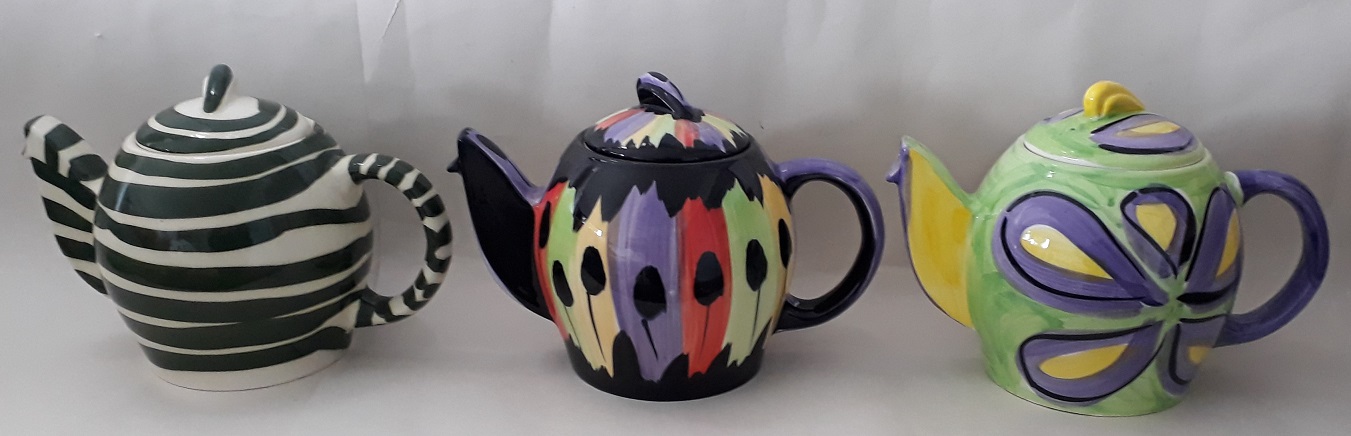
Above: Petra Ceramics teapots.  Petra created the design on the left for her own personal dinnerware.  Height 12 cm.

Above: Much of Petra’s output was in simple shapes and utilitarian dinnerware, cups and saucers and mugs, but there was also a market for more spectacular creations like this black and white range. Promotional photo, courtesy Bruce Haliday

At its height the factory employed 25 people, including ten decorators.   Petra required hard work and discipline from her staff: ‘I always told them, you don’t have to be artistic. You have to be punctual, you have to be tidy, you have to be fast, you have to be a good learner.’   One decorator pushed the boundaries, more interested in developing new patterns than fulfilling production quotas. One day when Petra had to go out, she gave the wayward young woman yet another pep talk. ‘I said to her, don’t play around.  You have got your list, you have got to finish what’s on the list.’  When Petra returned the decorator had once again not finished her list - but on this particular day she developed the Pacific pattern - a top seller for years.

Above: Pacific was one of Petra’s most popular patterns. The tallest vase is 30 cm.  Note the new teapot shape, far right. Promotional photo courtesy Petra Donath

Coffee was coming into vogue in the 1990s and Petra Ceramics did endless runs of mugs and latte cups and saucers, for both domestic and commercial use.  The most popular patterns were Pacific, Lemon, Blue Flora and Molle.  Petra kept her hand-painted patterns light and loose, always including a lick or two of black for definition. New designs were always a collaboration with the painters who could execute her ideas.

Above: Petra Ceramics mugs in popular patterns. From left: Pacific, Lemon, Hanna, Blue Flora, Molle.

Like other potteries, Petra Ceramics gained a lot of business from the commercial sector. Cafes – including Palmers’ Garden Centres and McDonald’s – wanted tea and coffee cups and plates. There was a steady demand for pure white ware for hotels, and big platters and bowls for caterers, supermarket food cabinets and delicatessens. There were even two sizes of juice containers for hotel dining rooms.  Some catering ware went to hotels in the Pacific Islands. Occasionally Petra made one-off patterns for a particular client.  Among others, there is a 60-year commemorative platter for the homeware chain Levene’s, and a tomato-themed serving dish for Dolmio – a giveaway for people who collected and sent in a certain number of spaghetti sauce labels.

Above: a hotel juice container. Height 25 cm. This holds four litres. There was also a wider eight-litre version.

Above:  Petra Ceramics Morocco pattern. Promotional photograph courtesy Petra Donath.

By the mid-1990s it was obvious there was room for more expansion, but Petra and Murray decided not to get any bigger – they felt they would be working even harder, for very little extra return.

Then in a few short years everything fell apart. In 1999-2000, Petra had a serious illness and while she was recovering, the business was sold as a going concern and Petra and Murray moved to the South Island.  They retained a lifelong love of ceramics, but never returned to the industry.

The new owner kept many of Petra’s patterns but there were also a few new styles such as the striking black and white Zebra design and new pieces including cat figurines, kidney-shaped bowls and ‘garden ball’ decorations .  Sadly though, the business had lost its driving force. Petra went back only once, and the factory was obviously in decline. Most of the staff had been put off work and there was an air of dirt and decay about the place.

In 2007 Petra Ceramics went into receivership and the factory closed permanently.


Above: From a Petra Ceramics 2003 brochure.  Courtesy Lesley Madgwick

Identifying Petra Ceramics

Petra Ceramics is generally very easy to identify. Almost all pieces are backstamped.  The first, from the late 1980s, carries the Petra Potz mark.  There are many variations on the Petra Ceramics theme, all used in the 1990s and into the early 2000s.


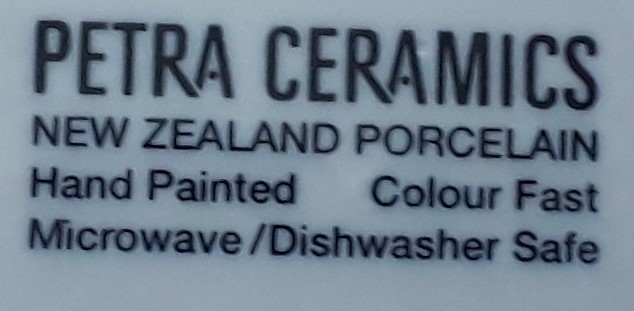
Petra also occasionally used stick-on labels.  Below, this label is on a hotel juice container


Below: This label is on the jug with a hand-painted duck. Petra is uncertain why it includes words in the German language. 


Below: this mark appears on a vase made after Petra had sold the business.  Used between 2000 and 2007


The information for this post came from an initial interview I recorded with Petra Donath in February 2016, along with several subsequent conversations.  Unless otherwise noted photos are mine, of pieces from my personal collection. 

END 


Monday, September 21, 2020

CHRISTINE HARRIS - the early days

Christine Harris was one of the first New Zealanders to make colourful, casual slipcast household pottery. This post tells how she began as a one-person operation, selling her work at the Auckland markets. My next instalment will tell the story of Studio Ceramics, where her designs were made on a commercial scale. 

This post includes photos from news clippings given to me by Christine. I have noted the source when available. 

Above: Christine Harris. Note the spectacular work displayed behind her. 
From the New Zealand Herald 2 June 1988

Christine Harris was a young mother living in Gisborne when she first learned to throw pots on a wheel.
 
In the late 1970s she moved back to Auckland with her small daughter Carly. After a successful venture into stone sculpture, Christine returned to ceramics, this time making and hand-painting slipcast ware.  Along with a handful of other pioneer designers she injected a jolt of colour and style into a market previously dominated by earthy brown studio pottery. 


Above: an early Hibiscus pattern bowl handcast by Christine Harris when she was still learning her craft. It was made in about 1983. Christine used variations on the 'CH' mark throughout her working life. 
Valerie Monk collection

By about 1983 Christine was selling boldly coloured platters, mugs, bowls and vases at Auckland’s busy Victoria Park Market. Later, an assistant was hired to sell at the Oriental Markets. Although her work was still clearly experimental, Christine could barely keep up with demand.  Some ware was cast at the workshop, but like many contemporaries Christine also bought ready-made blanks from Western Potters Supplies and decorated them for sale.
 
Even at this early stage the focus was on designs which were quick to decorate and instantly appealing.  Buyers queued for her work, especially for mugs with black and white stripes or bright blobs of cobalt blue.  Christine also experimented with teapots and cups and saucers. At first her decorations were hand-painted onto greenware then coated in clear glaze and fired. Later, decorated ware was bisque fired then clear glazed and fired again. 

Above: an early duo, hand painted in the pattern which was later known as Pacifico. 
Valerie Monk collection.

As Christine’s skills increased, she became more adventurous with colour and shape. Based in a series of small studios around central Auckland, including D’Art Studios and City Workshops, she worked alongside Bob Steiner and other up-and-coming artists.  At one stage the Limbs dance company rehearsed upstairs.  With advice from colleagues and from staff at Western Potters Supplies, Christine learned to shape, decorate and fire ceramics to a professional standard.  She made quirky vases, candlesticks, ‘happy pots’ and the occasional sculpture in bright colours and metallic glazes.  Black and white stripes and spots were recurring themes.  

Above: handbuilt vases from the mid to late 1980s. Image from 'Christine Harris Ceramics' brochure, 1990


Above: This hand-built bowl is from a 1987 series Christine called ‘Rough and Ready.’  
Height 7cm W15. 
Valerie Monk collection.

Christine says her slipcast and hand-built shapes and designs were deliberately ‘a bit wonky’ as opposed to the precise output of more traditional manufacturers. 


Above: hand- decorated Memphis style vases. 
Image from 'Buying from New Zealand.' Clipping undated, C1988   


Above: ‘Happy Pots’ from 1990.  Slipcast bodies were embellished with hand-built arms, legs and hats. Image from New Zealand 1990 Official Souvenir Publication.


Above: a vase from 1987.  The exterior is hand-decorated with a matt finish. The interior is glazed in shiny white. Christine usually dated her art pieces.  Height 23 cm. 
Valerie Monk collection. 

By the mid-1980s, Christine’s colourful work was stocked by upmarket design stores, where her towering Memphis-style vases sold for hundreds of dollars. A few pieces found their way overseas and one even featured in the New Yorker magazine.  


Above: a large vase in the Black Geometric pattern. 
Image from 'Christine Harris Ceramics' brochure, 1990

A pair of white vases with flashes of gold were accepted for the 1985 Fletcher Brownbuilt ceramics awards  but were unplaced. They were marred by firing cracks - Christine says she was still having technical problems with these complex shapes.   

Above: a vase in the same style as the Fletcher Brownbuilt entry. 
Image from 'More for House and Garden' magazine, clipping undated

Through most of the 1980s Christine Harris was working very long hours at her one-person operation. Then came the 1987 stock market crash. Many collectors lost their funds and could no longer pay for large art vases.  Christine quickly realised that her economic future lay in mass-producing smaller, less expensive pieces, especially the very popular Floral pattern dinnerware. Friends encouraged Christine to find a way to set up a factory - and that story will be told in my next post. 

Above: Floral dinnerware in 1990. Image from 'Christine Harris Ceramics' brochure.

ENDS